Lauterborn Blog Search

Monday, November 22, 2010

“House Sleuth” Uses Deductive Reasoning to Solve Date Puzzle

“House Sleuth” Uses Deductive Reasoning to Solve Date Puzzle:
Historian Bob Weingarten provides research keys at Society talk
(Appeared on 
Westport.Patch.com 11/22)
By Mike Lauterborn
© 2010. All Rights Reserved.
11/20/10

Westport, CT – It took months of research, thumbing through reams of documents and some good hunches for Bob Weingarten to finally determine the year in which his Greens Farm home was built.

The House Historian at the Westport Historical Society detailed the process in a “How to Date a House” presentation he gave late morning Saturday Nov. 20 in the Society’s Betty and Ralph Sheffer Gallery, 25 Avery Place. He was joined by Architect David Preusch, an expert in the restoration and renovation of historic residences, who added insight on how one’s home’s style illuminates its origins. The talk, which complemented the current exhibit “Putting Westport on the Map” (curated by Weingarten), was designed to give homeowners the tools to research the origins of their own homes.

Weingarten was introduced by Sue Gold, the Society’s Executive Director, who noted that the historian (and licensed real estate broker) also coordinates the town’s historic plaque-placing program for homes over 50 years old. He has placed over 80 plaques to date.

Weingarten’s introductory slide showed a photo of his converted-barn home and the headline, “How Old Am I?” He asked the modest gathering of attendees to guess the home’s age and received in reply answers that ranged from 1790 to current day. The home had had many modifications over time, so it was not surprising that dating it was a challenge for the audience.

However, this guessing game paled in comparison to all the detective work Weingarten had to conduct to accurately peg the home’s age.

“The basic process is to collect all that you can and use deductive reasoning,” the historian explained. “The first dating project I did was my house, which is how I got interested in this. The prior owners told us it was part of a 22-acre farm and that the house next door was the main house, built by Simon Couch. In 1975, our home was converted from a barn to a house.”

Weingarten said tax records indicated that the main house was built in 1783. Assessor’s records indicated the barn was built in 1887. It seemed suspect to Weingarten that the barn would have been built over 100 years after the main house, so that’s when he started digging.

Leveraging those dates, he went to the town’s Inventory List, which is maintained by the Westport Historic District Commission and includes 1,200 historic homes. The list gives details like address, historic name and year built. Unfortunately, there was no entry for the barn.

Changing gears, Weingarten then went to the Assessor again, with the prior owner’s name, and worked backwards to earliest property deeds and the original land-only transfer record. Back in the late 1700s and until 1820, taxes were assessed not on houses but on fireplaces – both size and quantity. The notation of a fireplace confirmed the existence and build date of the main house in 1783. Unfortunately, there was no mention of a barn, most likely because barns were not taxed until 1920.

Weingarten moved on to searching land records and Chain of Deeds available online through the Town Clerk. He noticed that the original owner sold the house in 1819. In the bill of sale, there was mention of “land and buildings”, though “buildings” was used as a general term back then and didn’t necessarily mean there was more than one structure on the property.

Forging on, Weingarten pulled an 1835 U.S. Coast Survey map noting a square and rectangle drawn on his property, the rectangle indicating a barn. That date, however, was still 50 years after the main house was built.

Knowing that the original owner died in 1808, the historian pulled a probate document noting that property of the deceased included “1 corn house, a Chaise house, shed and dwelling.” He discovered a Chaise is a fancy carriage and that the Chaise house must be the barn, which housed the carriage. Further, another survey map noted a small fireplace in the Chaise house and tax records for 1805 showed the addition of a fireplace on the property. Weingarten drew the conclusion that the new fireplace indicated the establishment of the Chaise house or barn in 1805.

“You put a lot of facts together and come up with a conclusion. You could be right or you could be wrong, but you’ve used a logical process,” summed up Weingarten.

Westport residents who would like to research the history of their own homes can visit the Westport Historical Society at 25 Avery Place on Tuesdays, between 10 and noon, when the records vault is open and researchers are available to help.


Sunday, November 21, 2010

Fairfielders Voice Hopes and Concerns on Education and the Community at United Way Forum

Fairfielders Voice Hopes and Concerns on Education and the Community at United Way Forum
Roundtable feedback will contribute to a nationwide report
(Appeared on 
Fairfield.Patch.com 11/21)
By Mike Lauterborn
© 2010. All Rights Reserved.
11/18/10

Fairfield, CT – A small group of Fairfielders made their voices heard about education and their town at a roundtable event billed as a “Community Conversation.”

Held early Thursday evening at the Audubon Society at 2325 Burr Street, the session was hosted by the United Way of Coastal Fairfield County. Operating out of Bridgeport, this regional group serves 12 coastal communities, focusing on education, health and the financial stability of families. This was the first of many community conversations that will be scheduled twice a month after Jan. 1 in the smaller suburban towns.

“The goal of these sessions,” according to Donna Pfrommer, EVP, Brand Management for United Way, “is to listen to ordinary citizens and learn what concerns them most about their community and its education system. In this way, we can modify and prioritize our current programming to meet community needs.”

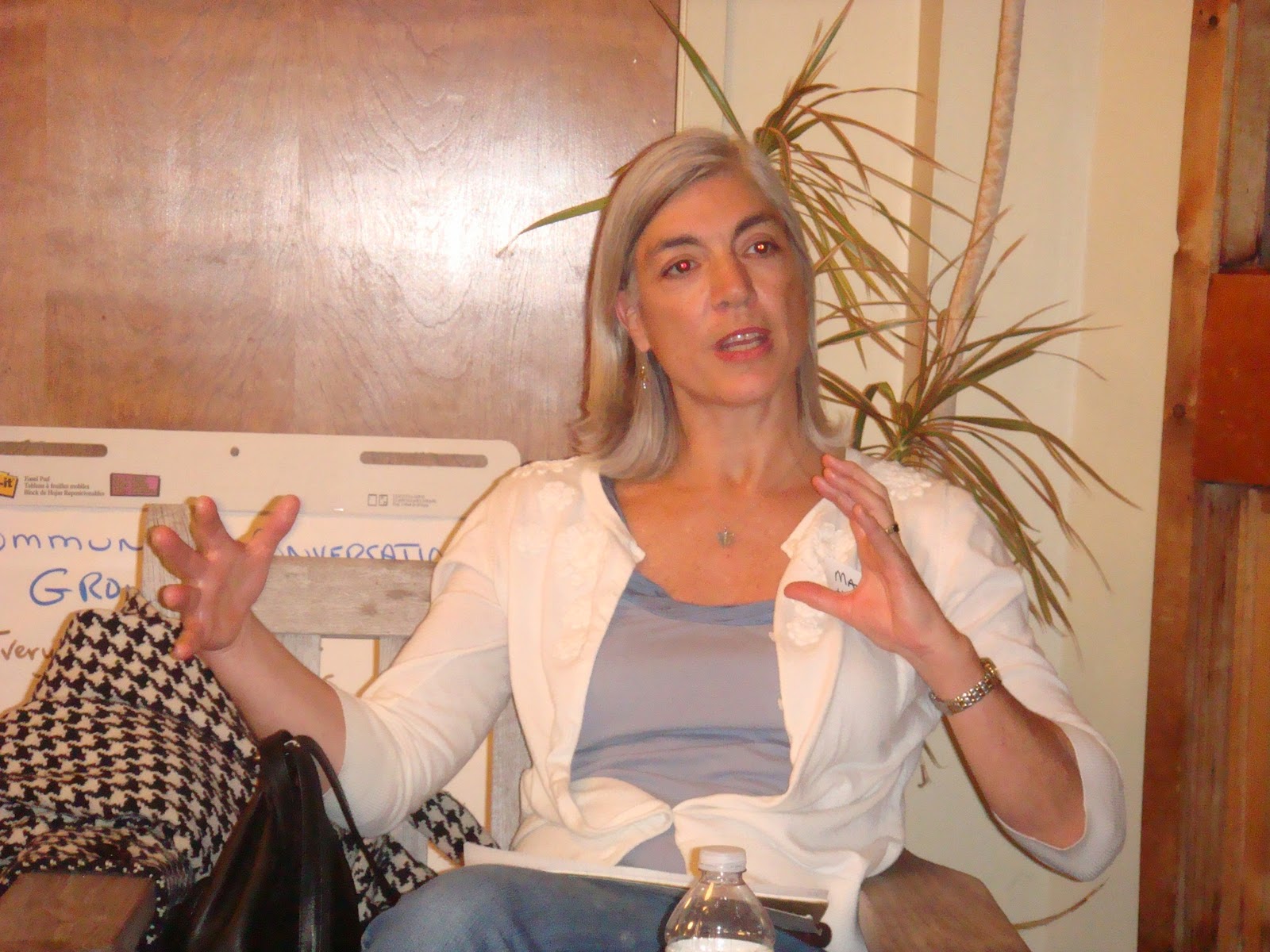
One attendee, Mary Hoag, President of the Fairfield PTA Council, said of the session, “This is a great opportunity for Fairfield to hear and talk about education. The PTA has a lot in common with the United Way in terms of its local and national focus and we want to learn from them and see how we can make a difference.”

Another attendee, Bob Hendrick, a VP at Bigelow Tea Co., said, “I’m interested in what the group has to say and how we can best utilize our education funds.”

Pfrommer led the roundtable, querying attendees about such topics as the kind of community they desire, top community issues and goals for education.

Attendees were united in their satisfaction with Fairfield as a spirited community. Chris McAleese, the Dora Wheeler Scholarship Committee Co-Chair with Fairfield’s PTA Council, said, “I’d like to keep what we have… the sense of neighborhood, its involvement, its generosity.” Hoag concurred, commending Fairfield’s civic-mindedness and ability to conduct discussions in which all viewpoints are heard. Catherine Giff, another PTA Council member and mother of three, echoed their sentiments, noting that Fairfield is a “verbal, engaged community.”

With regard to leading community issues, opinions varied. Giff believed it was key to “maintain balance between small and large neighborhoods” while McAleese said, “Redistricting and money are the two most perpetual issues in this town.”

As to goals for education, all agreed that there should be equal access opportunity, fewer government regulations and more balanced dedication of resources. Said McAleese, “Every kid should get the same shot. The Department of Education needs to compensate where there are inequalities and solve problems to keep it fair.” Hoag shared, “Sometimes there’s so much focus on special ed and gifted students that other students are neglected. Specific needs should be addressed in individual schools.”

To achieve Fairfield’s goals for education, suggestions were many. McAleese stressed the importance of strong PTA participation and that the PTA is key in spurring interaction and filling financial holes. Giff opined, “Parent involvement is key. We have some awesome parents.” Hoag suggested that parents be more educated about how the education system works and informed about the curriculum.

The regional United Way is one of 50 other networks across the U.S. initiating these conversations. Feedback like that gathered in this evening session will become part of a national report issued at the end of the calendar year.

“We hope the input we collect will help us build stronger communities and improve the educational system,” said Pfrommer.


Friday, November 19, 2010

Former GE Exec Applies Skills to Boost Ghana’s Plight

Former GE Exec Applies Skills to Boost Ghana’s Plight
(Appeared on the front page of the Fairfield-Sun 11/18)
By Mike Lauterborn
© 2010. All Rights Reserved.
11/5/10

Fairfield, CT – A career path change has led to new opportunity and a chance to make a real difference in an economically depressed climate for a former General Electric executive.

Maurice Johnson, 52, a Fairfield Beach Area resident, has had a career-long attraction and focus on Africa and is now applying his business experience to boost the agricultural output and financial well-being of Ghana. It has been a rewarding challenge and a winding road accented with unique interactions among a very different populace than what we are used to in Fairfield County.

Peace Corps

Born in Birmingham, Alabama and raised in Colorado, Johnson had always been fascinated with tales of Africa in both adventure books and movies. “It seemed like one of the last untamed frontiers,” Johnson felt, “and I really imagined I could make a difference there.”

So when he graduated from the University of Colorado in 1983 with a B.A. in Development Economics, he joined the Peace Corps and elected to go to Togo, West Africa, for his service term.

As an agricultural loan officer during the two-year stint, Johnson managed a team of 16 field agents. Their objective was to identify innovative, change-responsive farmers with needs and buy (on a loan basis) them a team of oxen and a plow, to replace their antiquated farming methods of using a hoe and shovel.

A typical day involved getting up at 4:30 a.m. and first tending to a farm that was part of their own facility. “There was an ox named Bubba that would kick me every morning,” he recalled with a smile. “We would plow and plant maize, sorghum and millet. These crops were sold at local markets and the revenue went into a revolving cash fund dedicated to re-lending to new farmers.”

As to the results of the loan program, Johnson reported a “99% lend and repay rate and double the crop production.”

The stay was not without its dark spots, however. “One day, one of our oxen wandered into a neighboring farmer’s cornfield and the farmer attacked it with a machete, badly scarring its hindquarters. We had to put the animal down.”

Though Johnson also said he always felt like an outsider, “The laughter and good feeling was always there. They know you’re trying to help out and wanted to work with you.”

Upon his return to the U.S. in 1985, Johnson enrolled at Johns Hopkins School of Advanced International Studies in Washington, D.C. He graduated in 1987 with a degree in International Finance with a geographic focus on Africa.

Corporate Career

That same year, Johnson joined the Overseas Private Investment Corporation, a firm that invests in private enterprise and emerging markets. As a regional manager for Africa, the Middle East and Asia, he was sent to Togo for a year to run a Free Trade Zone Project. Manufacturers situated in the zone did not have to pay tariffs or duties.

“I had my wife and nine-month-old son with me and there was a coup, in 1991. Since I was affiliated with the administration, I thought it prudent to leave,” he said. “When you’re looking out your office window and there are troops coming down the street hitting people, you know you’ve got to go. The airports were closed so we had to take a bush taxi from Lome to Accra and then flew back to the U.S. from there.”

In 1994, Johnson joined Citibank, managing project finance, and was transferred to Frankfurt, Germany. His workload included financing energy projects, aircraft engines and locomotives in several African nations.

Then, in 2000, he joined GE Capital as Managing Director of Proprietary Trade Execution, managing a global team for customer finance. In the role, he brought financing to projects in Ghana, the Congo, South Africa, Kenya and Senegal among other world locations.

His term at GE, which included a five-year assignment in London, spanned nine years, until 2009. During that time, he also moved to Weston then Fairfield.

New Challenges

“I was offered a chance to change careers, accepted a package from GE and moved on to new challenges,” said Johnson, about his split from the global giant. He confessed that this transition time was a little bit scary and uncharted as he had been used to managing teams and having all the perks of corporate life. He asked himself, “Where do I feel comfortable?” and decided to pursue consulting in Africa.

Johnson signed up for a volunteer program this past September, flew over to Ghana and began working with the U.S. Agency for International Development (USAID) to apply the skills he had acquired. He is now the leader to develop a grain market finance program with a goal of helping support grain growers with production and setting their market prices. Johnson explained that the benefits include better food security for local populations. The effort provides cash up front to help farmers buy equipment that will help them yield more crops.

An ancillary project is to provide suitable grain storage. “This is a pretty big deal as it’s a challenge to establish certified storage facilities,” said Johnson. “Current granaries incur significant spoilage and loss, leading ultimately to food shortages at the beginning of the following planting seasons. USAID is helping with improving agriculture on various fronts including better farming techniques and storage facilities.”

The Current Scene

Johnson works out of a house in Accra, the capital of Ghana and a city of about six million. The house has been converted into office space and he works with a team of five Africans. “They provide an enthusiasm and local connections that are essential to the work that we’re trying to do there.”

The situation is not without its site-based challenges. “There is extreme heat (100-degree plus temperatures), electricity outages and surges that often affect computer equipment and communications. These are core tools for us and when they are not available, it’s a real issue.”

Johnson added, “Transportation is difficult, with limited taxis available. All that said, we’re fortunate to have this working environment as the surrounding area is so financially depressed.”

Forward Looking Plans

Johnson said the key to success in Accra will be to get participation from major U.S. corporations that can meet energy and equipment needs. USAID is also in discussions to establish clean energy funds which will be dedicated to establishing systems that can process bio-waste. Ultimately, the goal is to continue to increase food production and help farmers be more profitable.

SIDEBAR

Ghana: A Proud Nation Seeking to be More Locally Productive

Fairfield resident Maurice Johnson, a consultant working for USAID in Ghana, can tell you first-hand that Africa is a very different place than our local community, but that its people have a special dose of pride that helps them deal with their hardships. They also have a plan to become more self-reliant.

“Africa… you don’t know it until you do it,” said Johnson. “Fairfield’s a lovely town but such a contrast with the areas I’ve experienced. You cannot believe it. They take four pieces of wood, put corrugated tin on top and that’s a house. Multiply that times thousands.”

“There’s such a great determination among the people that just drives you,” he added. “There’s a similar determination in Fairfield, but in Ghana there are much more modest circumstances. For example, because of a lack of electricity, students often come out in great numbers on moonlit nights to study.”

Johnson said that while many in Ghana have so little, they are proud, God-fearing and strong spirited, putting up with such hardships but always keeping their back straight. Referring to his secretary, he said, “Just to go back and forth to work, she commutes along dirt roads both on foot and by a crowded rural van from a very modest home in an outlying area.”

But Ghana has a plan to boost itself and is trying very hard to avoid the pitfalls of an oil-based economy by promoting its agricultural resources, Johnson claimed. In effect, this will enable a society wherein wealth is more fairly distributed among the people.

Johnson reported the discovery of two new oil fields just off the coast which can produce tremendous financial benefits. The downside is solely focusing on that industry at the expense of the country’s agricultural heritage. In effect, farming could be abandoned in pursuit of the riches of this new industry. “The net effect could be social dislocation, social unrest, pollution and mass migration to urban areas,” Johnson suggested.

He said the government recognizes this potential scenario, however, and is collaborating with groups like USAID to support agricultural investment and education. The government’s short-term efforts include forums wherein private business and government will strategize, dedication of funding to agriculture-oriented programs and bolstering of the Ministry of Agriculture in terms of enhanced authority to initiate programs.

“It’s all about the food security,” said Johnson. “This is the mantra of all of that.”


Thursday, November 18, 2010

Trattoria Ponte Vecchio: Classic Italian Cuisine Tapas Style

Trattoria Ponte Vecchio:
Classic Italian Cuisine Tapas Style
(Appeared in Dec. 2010 issue Fairfield County Life magazine)
By Mike Lauterborn
© 2010. All Rights Reserved.
10/7/10

Fairfield, CT – If you’re looking for a new spin on classic Italian cuisine, go no further than Trattoria Ponte Vecchio Cucina Italiana. Located at 1275 Post Road near the heart of Fairfield’s downtown in the Brick Walk Plaza, Ponte Vecchio offers old world inspired fare packaged in bite-sized, tapas-style portions.

The concept is the brainchild of Giannino Cavalli, the jovial 59-year-old chef/owner. Sporting close-cropped white hair, wire-rimmed glasses and a soft-spoken manner, Cavalli said, “That’s how we eat in Italy. Small dishes, lots of different things.”

There are an astounding 29 tapas items in all. “We want to give people the opportunity to try a variety of taste experiences. Our menu includes veal chops, seafood, pasta dishes and risotto,” explained Manager Rebecca Del Monte. The most popular tapas offerings are the Crostini Al Caprino (fresh figs and goat cheese over crostini, $7), the Costelette di Vitella (veal chops over mashed potatoes, $9), Torre Affumicata (fresh mozzarella and grilled eggplant, $7) and Gamberi All’aglio (sautéed prawns, $9).

Besides the variety of tastes, there are other benefits to the tapas-style selections said Cavalli. “You can have a full meal by having several tapas dishes. It’s economical and filling. Some people come and order seven or eight dishes and share… and that’s all they need.”

The tapas introduction is aligned with innovations in the lunch and wine menus, as well as an August 2010 spruce-up of the 2,000-square-foot eatery that included a new paint job and furniture, new booth upholstery, seating changes in its private room, added décor and more subtle lighting. These amendments only enhance the charming atmosphere, consisting of white clothed tables, large photo portraits of Venice and Florence, classic Italian music, a marble wine bar and low-lit elaborate sconces.

“People have really responded positively to the changes and new menus,” said Del Monte. Lest their regulars balk though, she added, “We have kept our original full-size meals, too, which our long-time patrons still like to order.”

“A traditional Italian meal starts with appetizers, salad, pasta and then the secondi, which is the main meal,” noted Cavalli, with regard to the other categories on the dinner menu. “In Italy, we also have fruit afterwards and finish with an espresso. It’s a lot of food!”

In the salad department, patrons can enjoy tasty creations like the Waldorf (a mix of greens, apples, dried cherries, walnuts, raisins, cherry vinaigrette) and Rucola Delizia (arugula, tomatoes, onions, almonds, gorgonzola, shallot vinaigrette).

Pastas fall in the $16-$21 range and as Cavalli put it, “No one pasta dish really stands out. They are all very popular.” He admitted to a personal favorite however: Spaghetti all’Aragosta (lobster and shrimp in a pink vodka sauce).

Secondi selections, priced at $20 on average, are headlined by veal dishes like Vitella Delicata (veal scaloppini with shitake mushrooms) and Vitella Milanese (breaded veal scaloppini topped with arugula, tomatoes and fresh mozzarella). Salmone Bianco (salmon in lemon and white wine sauce) and Pesce Siciliano (tilapia) are also popular.

Lunch fare includes a broad range of salads, panini ($7 on average) and lunch specials ($5 - $6.50) like fish, eggplant, chicken and pasta. A unique element is Ponte Vecchio’s Pasta Bar, which allows customers to mix and match a pasta and sauce and create their own dish, for a very reasonable $6 a plate.

Wines are mostly Italian and Californian and many are available by both the glass and bottle including Super Tuscans like Brancaia Tre, Prima Voce and Campa Cieni Rosso. There is also a full bar, specialty cocktails like the Bellini (peach schnapps and champagne) and Pamalini (pama liquor and champagne), and martinis.

Of course, no Italian meal would be complete without dessert. Nearly a dozen options are available from favorites like Crème Caramello (vanilla flan topped with caramel sauce) to Torta Di Ricotta (real Italian cheesecake made with ricotta).

Cavalli’s mother was his inspiration to pursue this line of work. “Anything she made was homemade… pasta, chicken… she raised the animals on her own. I learned by watching, a little bit at a time, and tried things.”

By the time Cavalli came to America in 1972 at age 20, he was “pretty much set.” He joined his brother Giulio at family-owned Luigi’s (also on the Post Road in Fairfield) and they operated it together from 1975 to 2003. It was then that Cavalli started what he called “the Ponte Vecchio adventure” with his wife Nancy and daughter Michela, now 32. The goal was to “provide very authentic Italian cuisine” though adjusted to meet American tastes, with the addition of cream to some dishes. “We don’t really do that in Italy, but some dishes call for it,” said Cavalli.

Family is an important part of the business. “Michela started working with me at Luigi’s when she was only 8 or 10 and was always around me,” said Cavalli. “After finishing school, she decided to come to work at Ponte Vecchio. She’s in charge of the bar, is the hostess, does the bookkeeping. I do the cooking, though occasionally she helps in the kitchen, too.”

Cavalli’s son Paolo, 33, manages two other family restaurants, called Cavalli Pizza, in Irving and McKinney, Texas, providing Neopolitan pizza as well as tapas selections. Zagat rated this offshoot as the best pizza in the country according to Cavalli.

The ying to Cavalli’s yang is wife Nancy. “She does all the public relations, talking to everybody,” said Del Monte. “She’s been 70% of this business’ success. People come here sometimes just for Nancy. They love her!”

Peppy, brown-eyed Del Monte, 23, whose own family owned a restaurant, is also one of the family, at least honorary. She joined Cavalli four years ago while a freshman at Fairfield University. Cavalli values her leadership and people-orientation. The latter attribute is key. “Customers are treated like family. They choose where they want to sit. We want them to be comfortable and relaxed.”

Cavalli claims that “the best advertising is our food” and personally ensures that it is always of the highest quality. “I am here seven days a week. I enjoy doing this. I don’t know how to do anything else. We are really thankful for our customers’ support all these years.”

Perhaps Del Monte best sums up the secret formula though. “Nobody ever leaves here hungry. The first thing Giannino says is, ‘Would you like something to eat?’ He talks to the customers like they’re his best friends, even if he doesn’t know them. He wants to make everyone happy.”

Ponte Vecchio is located at 1275 Post Road, Fairfield. 203-256-1326. For more information, visit www.pvfairfield.com

Girls Club Learns a Lesson about Being Thankful

Girls Club Learns a Lesson about Being Thankful
(Appeared on Fairfield.Patch.com 11/17) 
By Mike Lauterborn
© 2010. All Rights Reserved.
11/17/10

Fairfield, CT – A group of girls got a glimpse at hard times during the Great Depression and realized how thankful they are for their many blessings.

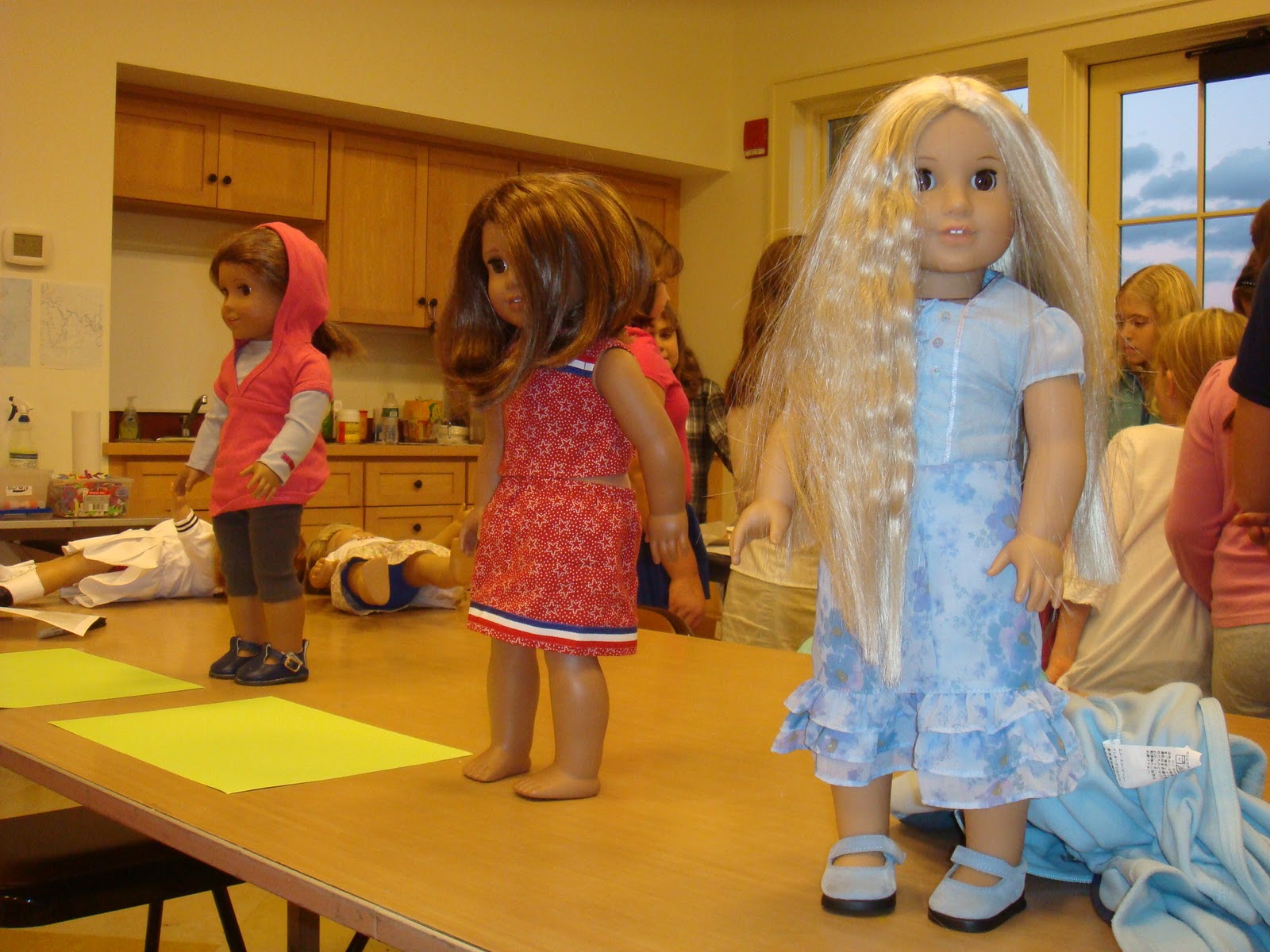
“Thankful with Kit”, a program presented Wednesday afternoon Nov. 17 at the Fairfield Museum and History Center, focused on Kit Learns A Lesson, a children’s story written by Valerie Tripp which is part of the American Girls book series. Set in 1934, it features main character Kit Kittredge, a clever young girl helping her family cope with the dark days of that era.

In the tale, Kit’s father has lost his business and the family is struggling to keep a roof over its head. When she participates with her school class in providing a Thanksgiving food basket to a local soup kitchen, she finds her father there and is determined to help change things for the better.

Kit, who enjoys writing, creates a one-sheet newspaper called “Hard Times” that seeks a handyman and cleaning help so the family can fix up their house and attract boarders to cover their expenses.

The program, led by the museum’s Director of Education Christine Jewell, gave seventeen Fairfield girls ages 7 to 10, who were participating in the museum’s monthly Girls Club session, the opportunity to mirror Kit’s activities.

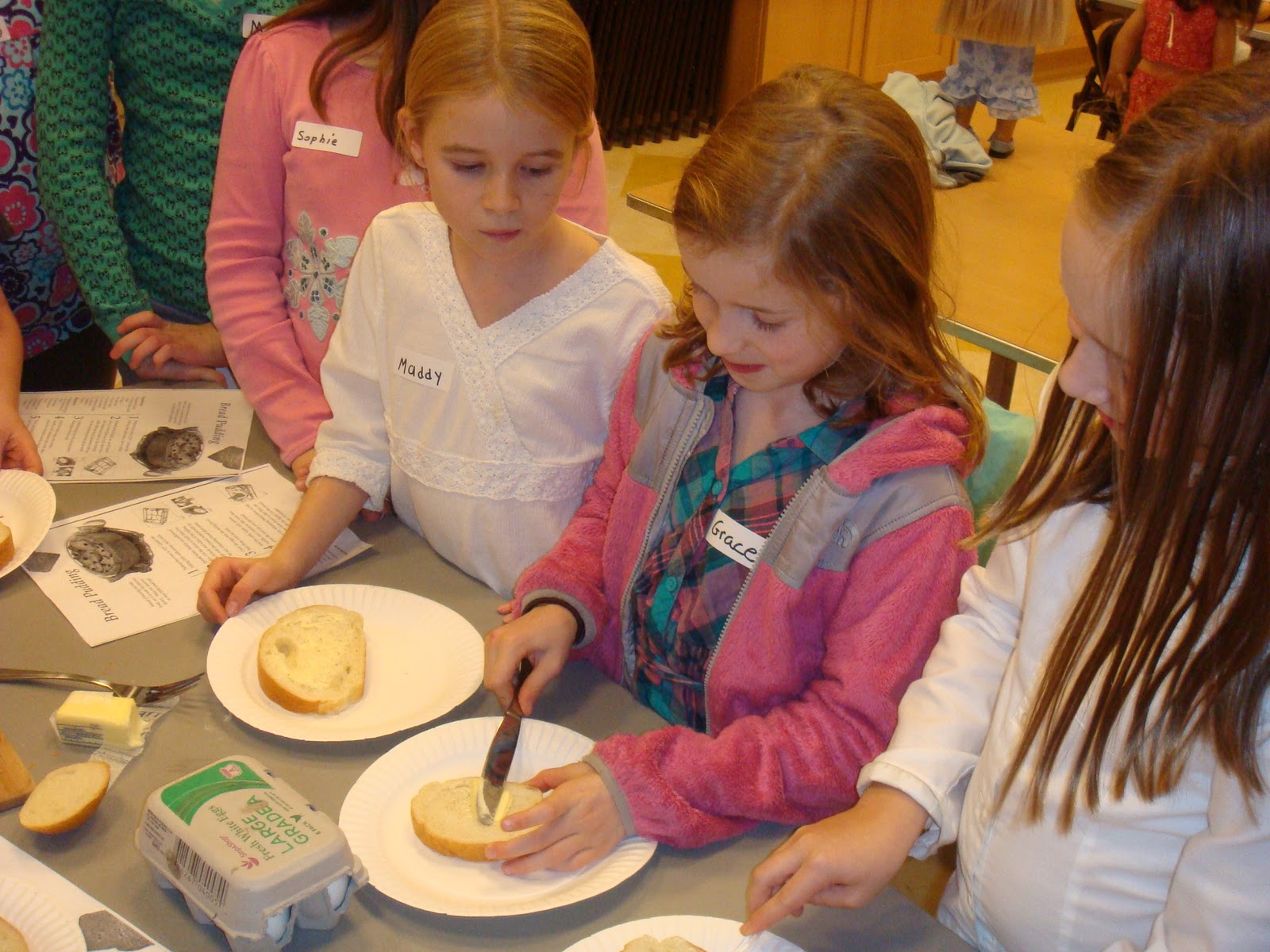
Creating what could pass as a food basket item, the girls collaborated on making a simple bread pudding. In the 30s, stale bread might be used, subscribing to a “waste not, want not” theory. Each of the girls handled a different step in the recipe, from buttering slices of bread and cracking eggs, to lining the pan and sprinkling raisins on top.

“What a great mess we made over here,” remarked Jewell as she placed the bread pudding into an oven to bake and sat the class down. Of the group, she asked, “Can you imagine not having enough money to live and having to take in boarders? Do you know anybody who doesn’t have a job?”

Many hands went up, signaling that people right here in Fairfield are experiencing their own hard times. When the girls took turns reading aloud excerpts from the book, they identified with Kit’s hardships. With this new appreciation, Jewell asked the group to create their own one-sheet newspapers and express both what they’re thankful about and what they wish.

Released to the gallery spaces of the museum, each girl outlined their project. Kate Burke, 10, a Faith Preparatory School student, wrote that she was thankful for her “pets, family, house and food”. Anna Paulmann, 7, a St. Thomas Aquinas student, was thankful for her “mom, dad and sisters.” Mary Collins, 9, a St. Ann’s student, wished her “family to be healthy.”

Upon return to the main activity room and the aroma of the baking bread pudding, the girls integrated these thoughts into their newspaper creations. With titles like The Katie Gazette, The Corrigan Post and the Fairfield Current, these took a cue from Kit’s paper but also exercised creative talents to include recipes, drawings, newspaper clippings and even ads for “help for hire” and puppies needing homes.

As the bread pudding and cups of lemonade made their way to the table, it was Addie Rush’s paper that may have best expressed the sentiment for the Thanksgiving season. Underneath the title “Happy Family’s” and colorful letters spelling out THANKFUL, Rush prominently placed the message, “I am thankful for my family and friends.” It appears Kit was not the only one who learned a lesson.  


Wednesday, November 17, 2010

Long-Term Needs the Buzz at Fire Commission Meeting

Long-Term Needs the Buzz at Fire Commission Meeting
(Appeared on New Canaan Patch.com 11/17
By Mike Lauterborn
© 2010. All Rights Reserved.
11/16/10

New Canaan – Long-term goals and needs were the terms that kept popping up at the monthly Fire Commission meeting and have certainly been a focus for residents town-wide. 

Commissioners Roger Williams, Sven Englund and Jack Horner as well as Chief Ed Karl, Fire Marshal Fred Baker and Assistant Chiefs Russell Kimes and Jack Hennessy met Tues Nov. 16 at the New Canaan Firehouse to cover an agenda that had long-range goals at its heart.

With regard to fire department equipment needs for the long-term, Hennessey presented a “wish list” of capital projects that is being tweaked for submission to the town the first week of January 2011. At the top of the list is a request for a Jaws of Life replacement, budgeted at $97K.

Said Williams, “Our current equipment is over 20 years old. Replacement is a necessity with a more advanced or higher tech version, due to the new construction of autos today. The metal technology and safety structure in new cars is both stronger, and roll cages are much more difficult to cut.”

Karl echoed Williams’ urgency, noting, “It takes an excessively long time to cut through some of the new cars. Audi’s and BMWs in particular. GM and other domestic auto manufacturers are now using the higher strength steel, too.”

Williams noted that a new Jaws of Life solution will be “two to three times more powerful than what we have” and that the equipment is particularly important as New Canaan is the primary responder for the Merritt Parkway, which he said is “all auto accidents.”

Another high priority on the capital projects list is a regional/mobile data system, pegged at $15K. Williams explained that the system consists of color display computer units that would be installed in the firetrucks and allow crews to access critical data about a structure as they arrive on the scene. Hennessey said the data would include building plans, water source locations, aerial photos, and gas and sewer line locations.

This mobile data system request is timely as Horner had reported attending a recent meeting of area first selectmen and fire chiefs to discuss long-term regional cooperation between small town fire departments. The ability for the NCFD to have this mobile technology can only enhance its ability to respond to situations and better help when called on by other towns.

Said Williams, “If the duty crew can access info more quickly, it can respond to challenges more quickly. It will have this at a push of a button.”

An additional budget priority is a new firetruck. Kimes is currently revising the economic underpinnings for the request, which is slotted at $610K – “as expensive as some building structures,” said Williams.

Engine #1 is 14 years old and Engine #4 is 10 years old. “When trucks start getting to 15 years, we start looking at replacing,” said Williams. He added, “A truck has been in the budget every year, and turned down every year. We did some fleet management changes this year to lengthen the service of the trucks in the fleet, but sooner or later, we will have to replace them. Even after budget approval, it would take approximately 18 months to two years to receive delivery.”

Williams summed up, “As the town is looking at long-range planning, so too are we. Localized resources and better hardware will provide a better level of fire safety to the residents of New Canaan.”


Hypnotist Helps Support Great American Smokeout

Hypnotist Helps Support Great American Smokeout:
Nov. 18 Event Encourages Smokers to Quit or Reduce Usage
By Mike Lauterborn
© 2010. All Rights Reserved.
11/16/10

Stamford, CT – According to the American Cancer Society, there are 44 million people who still smoke in the United States. Fortunately, there are various providers and organizations available to help.

In support of the Great American Smokeout Thursday, November 18, one provider, Stamford-based hypnotist Meg Tocantins, is offering a half-price program for smokers who decide to quit.

Since 1975, the American Cancer Society has devoted to the cause the third Thursday in November. On this day, smokers are encouraged to abstain from smoking all day or at least reduce their daily cigarette usage. Every year, millions of Americans participate in the activity, which often helps lead to permanent cessation of smoking.

To qualify for Tocantins’ half-price offer, smokers must contact her on Nov. 18 to schedule an appointment in the Nov. 19 to Dec. 31 window. To set an appointment, smokers can visit her website at www.relaxationsuite.com and click on “Contact Us” for specific instructions and guidelines, or call 917-292-8115.

Tocantins looks forward to the Great American Smokeout every year. “It’s a time when smokers are more aware of their habit.”

She has helped hundreds of people, who had tried other methods before and failed, quit smoking. She hopes her offer will give smokers more incentive to try to quit smoking, but to also consider hypnosis as a cessation solution.

“I give each smoker the tools they need to quit smoking forever. Most walk out of my office after the first session as non-smokers – they throw away their cigarettes. Later they tell me that quitting this time, using hypnosis, was easier than trying other methods,” she said.

The American Cancer Society has a dedicated website for the Smokeout event: www.cancer.org/Healthy/StayAwayfromTobacco/GreatAmericanSmokeout/index  It is designed to give smokers guidance, tools, information and resources to help them understand the cons of smoking and benefits of quitting. This includes tips and tools to help smokers quit for good, a Stop Smoking Quiz to help a smoker understand his/her smoking patterns and develop a personal quit plan, and downloadable tools to help plan a quit day.

The site also provides a Cigarette Cost Calculator so a smoker can see how much money is being wasted on cigarettes. For instance, a person that smokes one pack per day (or 20 cigarettes per day) for each of 365 days consumes 7,300 cigarettes. At an average of $9 per pack, that calculates to $3,285.

“When they come to me, most people have tried to quit a few times before, either with the nicotine patch, cold turkey or medications. It didn’t stick,” said Tocantins. “What hypnosis does is create an immediate cessation without the challenge other methods present like figuring out what do after quitting. What do you do while drinking coffee? Having a cocktail? These are real challenges. Smoking is a really nasty habit and ingrained in so many peoples’ lives.”

About the stigmas around hypnosis, Tocantins added, “Some people are hesitant about it and afraid that I’ll have them cluck like a chicken. I say to them, ‘I can’t get your ATM password. You’re always in control.’ The state that you’re in when hypnotized is a state all people can be in, though you will need to want to be hypnotized.”

Tocantins regularly monitors smoking trend reports released by both the American Cancer Society and American Lung Association, and said, “Smoking trends are always getting a little higher with youth, who think they’re going to live forever. In general, though, cigarette usage is gradually decreasing… which is great.”

“Women are not quitting as often as men, which I’m concerned about,” added Tocantins. “The high price of cigarettes is helping drive down usage.”